From Field to Fork — Measured.Tracked.
Canada wastes $49.5 billion in food every year — and has no national system to measure it. Harvest is the data infrastructure that changes that.
Annual food waste in Canada
Of all food produced is wasted globally
G20 nations track food waste
You Can't Manage What You Don't Measure
Canada produces enough food to feed 60 million people, yet 58% of all food produced is lost or wasted annually. That's 35.5 million tonnes — worth $49.5 billion.
Despite this, Canada has no national food waste measurement system. We are not one of the 4 G20 countries that systematically track food loss. Policies are made on estimates, not evidence.
Meanwhile, a regulatory tsunami is building. ISO 20001 (international food waste measurement standard) arrives in 2027. EU binding reduction targets hit in 2030. Canada's own SFCR already requires traceability — waste reporting is the obvious next step.
A regulatory tsunami is coming.
Regulatory Timeline
ISO 20001
International standard for food loss and waste measurement. Compliance will be expected across supply chains.
EU Binding Targets
European Union mandatory food waste reduction targets. Will impact Canadian exporters and multinationals.
SFCR / PCP
Safe Food for Canadians Regulations and Preventive Control Plans already require traceability. Waste reporting is next.
The Vision: Food as Medicine
Julie Dickson Olmstead has spent 8 years mapping Canada's food ecosystem — every node, every loss point, every opportunity to redirect surplus into nutrition. This is that vision.
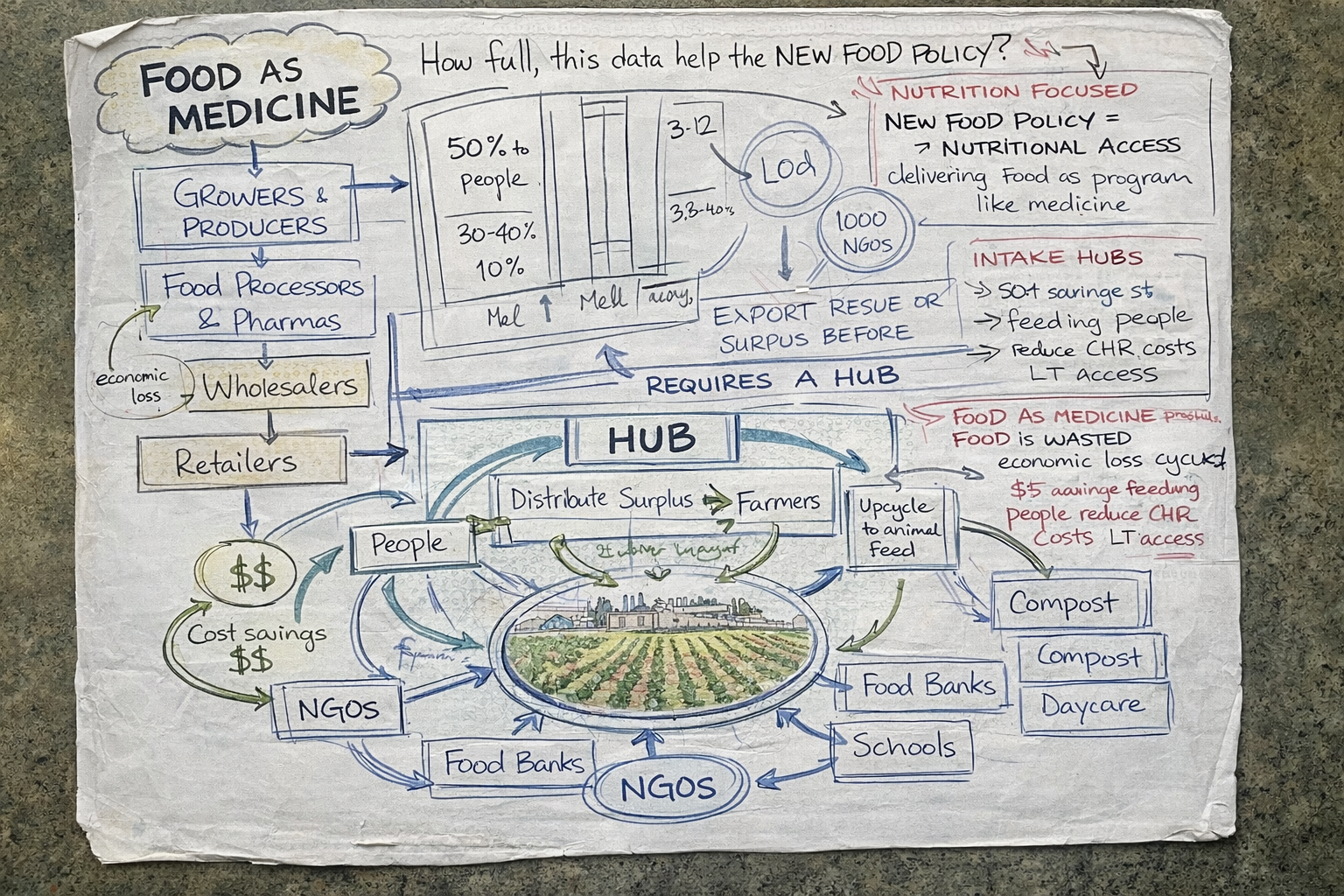
The original vision — Julie's napkin drawing, 8 years in the making
The Supply Chain Today
Food moves through a linear chain — growers & producers, food processors & pharmas, wholesalers, then retailers. At every handoff, economic loss compounds. By the time food reaches consumers, a staggering amount has been lost with no measurement, no tracking, and no recovery mechanism.
The Central Insight: It Requires a HUB
Julie's key insight — written right on the napkin — is that the system requires a hub. Not another point solution. A central node that connects every participant in the food ecosystem, captures data at every transition, and routes surplus to its highest-value use before it becomes waste.
Export & Reuse
Surplus before it spoils — redirect to where it's needed
Distribute to Farmers
Upcycle to animal feed, compost back to soil, close the loop
Feed People First
Food banks, schools, daycares, NGOs — nutrition over landfill
Where Food Should Go
The napkin maps the ideal distribution from the HUB. Today, these splits are invisible — nobody measures them nationally. Harvest makes them visible and optimizable.
Food banks, schools, daycares, NGOs, community kitchens. The highest-value use of surplus food — feeding people who need it.
Animal feed, compost, upcycled ingredients, biogas. Circular economy pathways that return value to the supply chain.
The irreducible minimum. Down from today's unmeasured 58%. When you can see the waste, you can shrink it.
Intake Hubs: The Economic Case
Julie's napkin shows it in red: $0+ savings, feeding people, reduce chronic health costs, long-term access. This isn't charity logistics. It's a nutrition-focused infrastructure play where redirecting food to people is cheaper than letting it rot.
The vision connects directly to Canada's New Food Policy — nutritional access, delivering food as a program, food as medicine. With 1,000+ NGOs downstream and 3-12 local distribution networks per region, the HUB becomes the backbone that makes policy actionable.
Downstream Recipients
Food Banks
Direct surplus routing with predictive inbound forecasting
NGOs & Community Orgs
1,000+ organizations connected through regional intake hubs
Schools & Daycares
Aligned with national school food program — 400,000 children annually
Compost & Upcycling
Circular economy pathways — animal feed, biogas, soil amendment
Written at the top of Julie's napkin:
“How full, this data help the NEW FOOD POLICY?”
New Food Policy = Nutritional Access. Delivering food as a program — like medicine. The data infrastructure Harvest builds is how Canada turns food policy from aspiration into measurable outcomes.
Who We Serve
Seven stakeholder groups, one connected ecosystem. Each has unique pain points — Harvest solves them with shared infrastructure.
Farmers & Producers
No standardized way to measure or report food loss at the farm level. Regulations are coming and they have zero infrastructure to comply.
IoT-connected harvest tracking, automated FLW Standard reporting, and CEA (controlled environment agriculture) pilot programs.
Compliance-ready before ISO 20001 (2027). Reduced waste visibility unlocks premium market access and grant eligibility.
Model: Per-acre SaaS + hardware lease
Food Processors
Processing losses are invisible — estimated at 20-30% of input volume with no measurement tools. EU binding regulations (2030) will require disclosure.
Real-time throughput tracking, waste categorization dashboards, and regulatory pre-compliance reporting aligned to FLW Standard.
Identify the 20-30% loss window. Turn waste data into ESG reporting asset and regulatory shield.
Model: Per-facility license
Retailers & Grocers
Shrink is the #1 profit killer. $4.8B annually in Canada, but retailers lack granular category-level waste data to act on it.
SKU-level waste tracking integrated with existing POS systems. Predictive ordering to reduce over-purchase. Donation routing to food banks.
1-3% margin improvement from shrink reduction alone. Regulatory compliance + ESG reporting built in.
Model: Per-store monthly + analytics tier
Food Banks & Charities
Receive unpredictable donations with no visibility into what's coming, when, or in what condition. 60% of donations are last-minute.
Connected donation pipeline from retailers and processors. Predictive inbound forecasting. Nutritional impact tracking.
Transform from reactive recipients to planned distribution networks. Prove nutritional impact to funders with real data.
Model: Free tier (grant-subsidized)
Industry Associations
CPMA, CFIG, and others need member intelligence to shape policy, but have no aggregated data across the supply chain.
Anonymized, aggregated member benchmarking. Regulatory radar for upcoming standards. Industry-wide trend reports.
Become the authoritative voice on food waste data in Canada. Drive policy with evidence, not anecdotes.
Model: Annual association license
Government & Regulators
Canada is NOT one of the 4 G20 nations that track food waste. No national baseline exists. Policy is flying blind.
National food waste data infrastructure. Real-time dashboards for AAFC, ECCC, and provincial agencies. Export-ready data products.
Finally establish Canada's FLW baseline. Enable evidence-based food policy. Position Canada as G7 data leader.
Model: Data product licensing + consulting
Impact Investors & VCs
AgriTech is the fastest-growing vertical ($69.8B → $136.2B) but most plays are point solutions with no platform moat.
Harvest is infrastructure, not an app. Multi-sided platform with network effects: every new node increases data value for all participants.
$49.5B addressable waste problem. Government co-funding (75% eligible). First-mover in a market with zero incumbents tracking at national scale.
The Platform
Four phases, each building on the last. From regulatory intelligence to national data infrastructure.
Regulatory Intelligence
Q1-Q2 2026
CPMA "Able" platform — regulatory radar, compliance tracking, and member intelligence for Canada's produce industry.
Food Waste Data Platform
Q2-Q4 2026
FLW Standard-compliant measurement tools. IoT integration, waste categorization, and reporting for processors and retailers.
Agriculture Data Hub
2026-2027
IoT sensor networks, CEA pilot programs, and CAAIN-funded research infrastructure. Farm-level data at national scale.
National Infrastructure
2027+
Government data products, provincial dashboards, export-grade analytics. Position Canada as G7 food data leader.
Regulatory Intelligence
CPMA "Able" platform — regulatory radar, compliance tracking, and member intelligence for Canada's produce industry.
Food Waste Data Platform
FLW Standard-compliant measurement tools. IoT integration, waste categorization, and reporting for processors and retailers.
Agriculture Data Hub
IoT sensor networks, CEA pilot programs, and CAAIN-funded research infrastructure. Farm-level data at national scale.
National Infrastructure
Government data products, provincial dashboards, export-grade analytics. Position Canada as G7 food data leader.
Global Context
The countries that track food waste are already seeing results. Canada isn't one of them — yet.
South Korea
95%Weight-based pricing system — residents pay per kg of food waste. Achieved 95% food waste recycling rate.
Japan
31%Reduced food waste by 31% since 2000 through mandatory reporting and industry-government collaboration.
UK (WRAP)
18%WRAP's Courtauld Commitment achieved 18% per-capita reduction through voluntary industry targets and public campaigns.
European Union
2030Binding food waste reduction targets coming in 2030. Will require measurement infrastructure across all member states.
🇨🇦 Canada is NOT one of the 4 G20 countries that track food waste.
No national baseline. No measurement infrastructure. No way to prove progress on federal food policy commitments.
Global AgriTech market
Funding Strategy
Canada's grant ecosystem is uniquely aligned with agriculture data infrastructure. Two stacking layers of non-dilutive capital.
Grants
AI in agriculture
Innovation assistance
Scale Funding
AAFC cluster program
$5-8M over 3 years
Stacking strategy
75% government assistance
Maximum eligible assistance
Join the Coalition
Canada's food ecosystem needs a measurement backbone. Whether you're a farmer, processor, retailer, association, government agency, or investor — there's a seat at this table.